A checkweigher, metal detector, X-ray inspection system, or other quality-control device can identify a product that does not meet the required condition. But on an operating packaging line, detection is only part of the job. The product still has to be removed from the flow in a controlled way, the surrounding equipment has to respond correctly, and acceptable product has to keep moving downstream. That is where the design of the checkweigher reject system and the integration around it become critical.

For manufacturers working with an existing line, the question is usually not whether inspection technology exists. The real challenge is how to connect the inspection device, product handling, reject method, controls, and downstream equipment so they operate as one coordinated system. Kraken Automation approaches this work as part of a broader secondary-packaging integration problem rather than as an isolated machine purchase.
Standard pneumatic pushers, air reject systems, mechanical diverter arms, and retracting conveyors can all be appropriate depending on the product and application. The challenge is making sure the reject method matches actual product behavior, spacing, speed, package stability, and containment requirements.
For a checkweigher reject system or metal detector reject system, the inspection device determines whether the product passes or fails, but the reject equipment still has to remove that product cleanly without disturbing the following product. Pushers and air rejects may work well when spacing and product characteristics are controlled; other products may call for a different approach.
Open, fragile, unstable, or orientation-sensitive products add another layer of difficulty because the reject action can affect product integrity as well as line flow. Retracting conveyor designs can also be effective in the right application, but the product, belt arrangement, available space, and downstream path all need to be considered as part of the overall design.
For higher-speed applications or products that are difficult to handle, a guided reject approach can provide more control through the transition. Depending on the application, product can be moved from one path to another while maintaining orientation and stability. This can be especially useful with open containers, fragile packages, or products that cannot tolerate a sudden impact or uncontrolled movement.
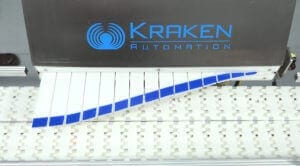
Kraken also integrates divert systems and other product-handling functions when the reject requirement is part of a larger routing or flow-management problem. The right configuration depends on the product, inspection decision, reject path, line speed, controls, and the equipment immediately upstream and downstream.
Whether adding new inspection equipment or updating an existing line, the reject system should be treated as part of the complete packaging-line interface rather than as an isolated component. A reliable solution has to coordinate the inspection signal, product handling, reject timing, controls, recovery after stops, and the requirements of downstream equipment.
Kraken Automation provides packaging-line integration around new and existing machinery and can integrate partner/OEM inspection equipment when the application calls for it. That allows the checkweigher, metal detector, X-ray system, reject device, conveyors, and downstream packaging equipment to be engineered as one coordinated system instead of a series of disconnected machines.
The best reject method ultimately depends on the product and the line. When product integrity, spacing, orientation, speed, inspection requirements, and plant-floor constraints are considered together, the system can remove failed product while keeping acceptable product moving predictably through the rest of the line.
Have an existing inspection or reject application that needs to be integrated into your packaging line? Contact Kraken Automation to discuss the product, line rate, inspection equipment, controls, and surrounding machinery.
What is a checkweigher reject system?
A checkweigher reject system combines in-line weight inspection with a reject method that removes products that fall outside the defined weight criteria. The reject method should be matched to the product, spacing, line speed, stability, and surrounding equipment.
Can metal detectors and X-ray inspection systems use automated reject systems?
Yes. Metal detectors, X-ray inspection systems, checkweighers, and other inspection technologies can be integrated with automated rejection. The best reject approach depends on the product and the conditions of the packaging line rather than on the inspection device alone.
Can Kraken integrate inspection equipment from another OEM?
Yes. Kraken can integrate partner/OEM inspection equipment into new or existing packaging lines and coordinate the product handling, controls, reject function, and downstream routing as part of one system. Learn more about Kraken’s packaging-line integration capabilities.
What should be considered when adding a reject system to an existing packaging line?
Key considerations include product behavior, spacing, line speed, reject timing, available footprint, controls and machine communication, upstream and downstream equipment, and how the line should recover after a stop or fault.
When is a guided reject system useful?
Guided reject handling can be useful for fragile, open, unstable, or orientation-sensitive products where maintaining control through the transition is important. The specific mechanism should be selected around the application; Kraken also integrates divert systems when rejection is part of a broader routing or flow-management requirement.
Kraken Automation is an innovator in the packaging automation industry, and well-known for its expertise in developing customized solutions that solve the most complex packaging challenges. Get in touch with us today to see how we can help you optimize packaging line efficiency.
