SYSTEM PROBLEMS
A packaging line can have good equipment and still perform poorly. One machine stops and everything backs up. Another runs faster than the equipment downstream. Products arrive at the next machine in the wrong position. There is not enough accumulation. A merge is starving one lane and flooding another. Operators are constantly stepping in to move, turn, space, or recover product.
Those are not always equipment problems. They are often system problems.
Kraken Automation, an Excelis company, works with manufacturers to solve the problems that happen between machines and across the line. We integrate new and existing equipment, develop custom product-handling solutions, and improve the way products move through a packaging process without assuming the answer is to replace the entire line.
SYSTEM INTEGRATION
Most line-performance problems show up in a few predictable places: product flow, accumulation, orientation, transfers, controls, and mismatched machine rates. A filler may be capable of the required speed, but if product cannot move consistently into the next process, that speed does not matter. The same is true for wrappers, cartoners, case packers, inspection systems, and other equipment throughout the line.
The challenge is understanding why the line is losing performance. Adding more conveyor does not automatically solve a backup. Increasing machine speed does not help if the next process cannot accept the product. Replacing equipment may be unnecessary if the real issue is how machines are connected, controlled, or buffered.
That is where system integration matters.
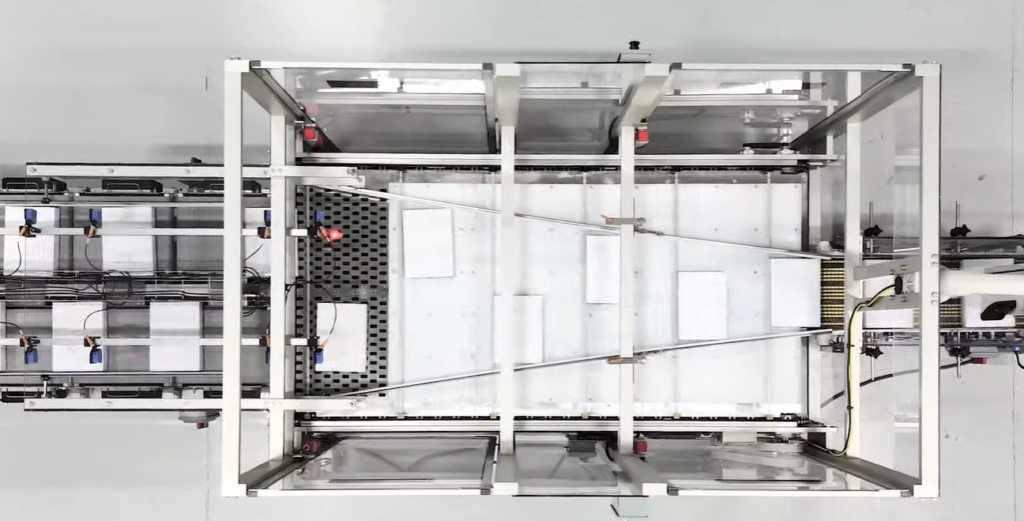
Products do not always leave one process in the position, lane, or orientation required by the next. That can create the need for merges, diverts, lane balancing, rotation, upending, spacing, or other product-handling steps.
These systems have to work at production speed without damaging product or creating a new bottleneck. Kraken designs around the product, the required movement, the available space, and the equipment on both sides of the process.
Not every project is a new line.
A manufacturer may need to add a case packer, replace one machine, create another lane, add inspection, change product orientation, or improve one difficult transfer. The rest of the line may still be perfectly usable.
Kraken works on these partial-line projects every day. The goal is to solve the actual production problem while preserving equipment that still does its job.
Packaging lines often include equipment from multiple manufacturers, installed at different times for different reasons. Each machine may operate well on its own while the overall line struggles.
Kraken integrates equipment from different OEMs by addressing the physical interfaces, product transfers, controls, timing, accumulation, and line logic that allow those machines to function as one system. This applies to both new equipment and machines already on the plant floor.
When one machine stops, slows, or changes rate, the impact can travel quickly through the rest of the line. Proper accumulation, buffering, conveyor control, and line logic can give equipment time to recover without immediately shutting down upstream production or starving downstream equipment.
Kraken evaluates how the line actually behaves during normal production, stops, restarts, and changeovers. The solution may involve accumulation, control changes, revised conveyor layouts, or better coordination between machines.
The best solution is not always another machine.
Sometimes throughput improves by changing the way product moves between existing machines. Sometimes the line needs more accumulation. Sometimes a new piece of equipment does need to be added, but the real engineering work is making that machine fit the process around it.
Kraken Automation looks at the complete system before recommending a solution. That means understanding the product, machine rates, controls, available footprint, operator interaction, upstream constraints, downstream constraints, and what production needs to look like in the future.
The result may be a small modification to one section of the line or a larger integrated system. The scope follows the problem.
Yes. Many integration projects involve only one section of an existing line. That may mean adding accumulation, changing a transfer, integrating a new machine, adding a merge or divert, improving product orientation, or solving a bottleneck between two existing machines.
Machines need compatible product flow, controls, speeds, interfaces, and safety logic. A system integrator coordinates those requirements so equipment from different manufacturers can operate as part of one production process.
That is often an integration problem. Product transfers, accumulation, controls, machine timing, line balance, orientation, and routing can all reduce overall performance even when the primary equipment is operating correctly.
Start by looking at what happens between the machines. Better accumulation, transfers, controls, lane balancing, merging, and product routing can sometimes recover capacity that already exists within the equipment on the line.
The new machine has to fit more than the available floor space. Product presentation, conveyor elevations, machine rates, controls, accumulation, upstream supply, downstream capacity, and operator access all need to be considered as part of the integration.
The slowest machine is not always the true bottleneck. A line may lose production because of poor transfers, recurring downstream stops, insufficient accumulation, unstable product handling, or controls that do not coordinate the equipment effectively. Reviewing how the complete line behaves during actual production usually reveals where capacity is being lost.
Backups are often caused by mismatched machine speeds, insufficient accumulation, poor transfers, intermittent downstream stops, or control logic that does not adequately coordinate the equipment.
The objective usually isn’t to eliminate accumulation. It is to control it. Proper accumulation gives downstream equipment time to recover without immediately forcing upstream machines to stop.
Starving and blocking are line-balance problems. Proper accumulation, line controls, conveyor speeds, sensors, merges, and buffer capacity allow machines running at different instantaneous speeds to operate together more effectively.
Accumulation needs to provide usable buffer time without damaging or jamming products. The correct approach depends on product characteristics, line speed, equipment stop frequency, and recovery time.
Kraken Automation approaches bottlenecks as system problems. That means reviewing equipment speeds, transitions, accumulation, controls, product handling, routing, and downstream constraints before determining the appropriate solution.
Throughput can sometimes be improved by changing what happens between machines rather than replacing the machines themselves. Better accumulation, product routing, transfers, controls, lane balancing, and line synchronization can recover lost capacity.
Evaluate machine speeds, transfers, spacing, conveyor control, accumulation, product stability, and stop-start behavior. Often the individual machines are capable of the required production rate, but the system connecting them is limiting throughput.
A systems integrator can help match the new machine to older equipment by addressing controls, interfaces, conveyors, elevations, speeds, product presentation, and safety requirements. Kraken works with equipment from multiple manufacturers in both new and existing lines.
Kraken Automation evaluates packaging bottlenecks as system problems. That includes machine speeds, product flow, conveyors, controls, accumulation, transfers, orientation, and downstream restrictions.
Adding a lane requires a lot more than duplicating the conveyor. The upstream product supply, downstream capacity, controls, lane balancing, merges, diverts, and available space all need to be considered.
Buffering can be created through accumulation conveyors or other product-storage methods designed to absorb temporary differences in machine operation. The amount and type of buffer should reflect actual line behavior rather than simply adding more conveyor length.
If products are backing up, machines are starving, operators are constantly intervening, or a new piece of equipment needs to fit into an existing process, the first step is understanding how the entire section of the line is working.
Kraken Automation, an Excelis company, designs and integrates packaging systems that keep products moving precisely, reliably, and at production speed.