A food manufacturer approached Kraken Automation with a critical downstream packaging challenge. Frozen product was being delivered from three wrappers into three cartoners, but the existing system had little flexibility. If one wrapper or cartoner stopped, the entire line lost throughput and production targets could not be maintained.
The customer’s goal was clear: develop an automated system capable of maintaining 220 products per minute, even if one of the three lanes went down. The system needed to dynamically adjust speeds, redirect product between lanes, and merge product streams as needed—all while operating within a limited plant floor footprint.
To fully define the requirements, the customer presented 16 different production scenarios the system needed to handle. Each scenario accounted for different combinations of wrappers and cartoners being offline. Regardless of the situation, the line needed to continue running at production rate.
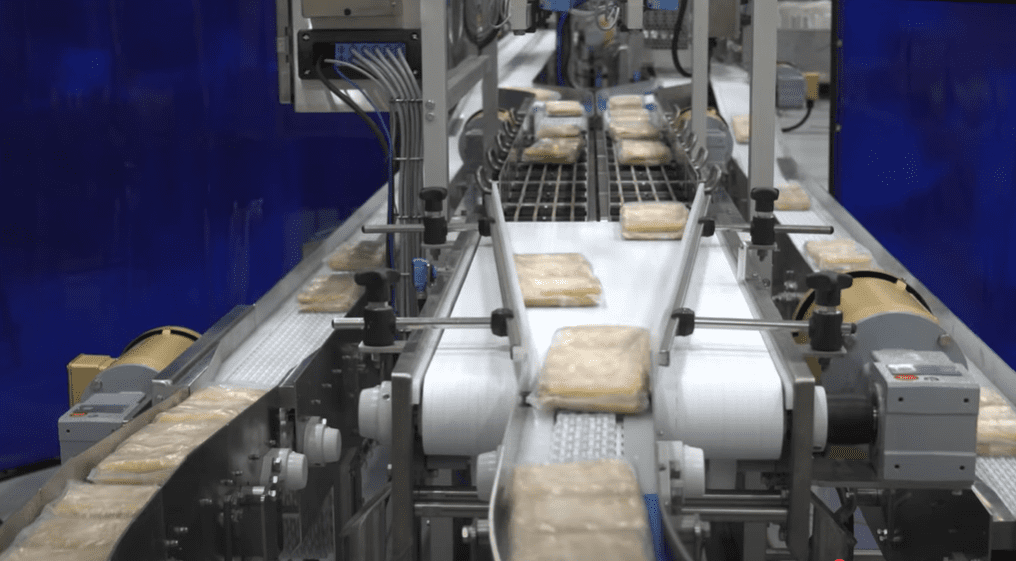
Kraken evaluated the application from a system integration standpoint, focusing on how to maintain stable product flow under multiple operating conditions. The engineering team determined that a series of inline merge/divert systems would provide the flexibility required to route product between lanes and keep the line operating at target speed.
Both the mechanical and controls engineering teams collaborated to develop a coordinated system that could automatically manage product routing based on the status of upstream wrappers and downstream cartoners.
The resulting design allowed the system to:
During the design phase, the customer introduced an additional requirement: the system needed to allow operator walking access through the line.
This meant several areas of the system required walk-through access points that would allow operators to move safely through the equipment. Kraken incorporated pull-nose conveyor sections at these locations so conveyors could be temporarily stopped and restarted without disrupting the broader production flow.
The controls architecture was designed to allow these areas to pause and resume operation while the rest of the system continued to function normally—ensuring production stability without requiring manual intervention.
The final integrated system included:
Kraken’s experience designing and building merge/divert systems was central to achieving the required flexibility and reliability.
The customer requested a formal Factory Acceptance Test (FAT) prior to shipment. Over several days, the system was run through the required production scenarios.
During testing, the customer introduced additional real-time functional scenarios, expanding the original test plan. These scenarios were implemented and verified during the FAT process. Minor control adjustments were identified and resolved at that time.
The collaborative testing process allowed the customer to validate system performance and build confidence before installation.
Following the FAT, the system was shipped for installation and commissioning at the customer’s facility.
While only burst testing could be performed during FAT, the installed system demonstrated full operational capability once connected to the production line. The system successfully handled all operating scenarios presented by the customer and maintained the required 220 products per minute production rate.
Most importantly, the line can now continue operating when individual wrappers or cartoners go offline—something that was not possible with the previous configuration.
With the Kraken system in place, the customer gained a reliable downstream packaging solution capable of maintaining production under multiple operating conditions. The system continues to operate within the required parameters and provides the flexibility needed to keep the line running even when individual components of the process are unavailable.
For the customer, this means improved production stability, better utilization of existing equipment, and a system designed to adapt to real-world operating conditions.